
Today marks the first part of a soliloquy on *drum roll* consciousness. Oh, wunderbar, I can hear you groan: another lengthy discussion from a word-mongering amateur.
Well, yes, possibly.
So! where to begin...
I need to start with a modest assumption about consciousness
before starting off. I'll assume (and perhaps you do as well)
that we humans are rather fragile creatures,
and that when our bodies wear out with time (or rogue buses),
when our bones ache and our brains struggle to thrive,
that our mind is essentially destroyed, finished, kaput.
A little frightening, perhaps, but hey,
could you ask for a better reason to live life?
So this life, this body, this...brain, it's all that we've got to work with for now (unless you fall in with Kurzweil or the Vatican, to name a few).
Okay, okay, I hear you scoffing. "So we die, and that's it. Not exactly worth a trip to meet the king of Sweden." Fair enough.
Let's get to the thick of it.
What is it about our sensibilities towards consciousness that makes arguments against free will so damn unsettling?
Well, to take a stab at answering the question, it might be useful to think about what kind of arguments are being made, and (perhaps more importantly) how they are being made. What does this mean?
Consider the following analogy made by the late, great Douglas Adams, when trying to dissuade his audience from any lingering attachments to the anthropic principle:
"Imagine a puddle waking up one morning and thinking, "This is an interesting world I find myself in — an interesting hole I find myself in — fits me rather neatly, doesn't it? In fact it fits me staggeringly well, must have been made to have me in it!" This is such a powerful idea that as the sun rises in the sky and the air heats up and as, gradually, the puddle gets smaller and smaller, it's still frantically hanging on to the notion that everything's going to be alright, because this world was meant to have him in it, was built to have him in it; so the moment he disappears catches him rather by surprise."
So you might be thinking: Okay...I think I see what he's saying.
I get the whole "don't be a schmuck,
nature doesn't have to keep you around,
you're no special hotshot in the cosmos, yes yes".
but what the hell does this have to do with consciousness?
Alright, here's where it might get interesting.
Think about the kind of analogy that Adams is trying to persuade us with.
In order to show that our fixation with "just so" conditions is a bit unjustified, he likens this yearning for a kind of "specialness" to the musings of the puddle, who conveniently enough also resides in a physical world.
But...(and let me be explicitly clear that this is not an endorsement of religious ideologies)
...there is a bit of a problem.
Let's consider the world of the puddle, from the perspective of some variety of "designer".
Now the puddle, which is physical, resides in his environment pretty much exactly like we do, except perhaps for the benefits of remarkable advances in twig technology. But in order to be consistent with the ideology, we'd have to say that the "designer" had at least some say in the creation of both the puddle and the swell little niche he dwells in.
Now wait a second, I can hear you object. Hold the phone, you might cry out.
Isn't that an absurd extension of the philosophy?
Well, not so much, if you think about it.
We could hover around the scale between Newton's watch-maker and the heaver interventionist models, but the fact remains that if it's part of a creation, some thought must have been given to its arrangement.
(For those of you tempted to respond with a crack about the seemingly alien-ness of the platypus, I challenge you to find a more elegantly crafted critter for the circumstances.)
If you're willing to cede me that point, consider this next point. Adams, if trying to argue within a creationist framework, has gone and painted himself into a corner.
Option one: he could take a physical example, anthropomorphize it so we can ridicule the ignorance, and point out the absurd nature of our fallacy. But then "aha!" the creationist might declare triumphantly. "Of course the hole was made special for the puddle. He's part of creation!"
or...
Option two: He could simply use a non-physical example and...er...wait a second...
Now, this is by no means an argument against Adams' point. The odds are terrific given simple historical observation that the life of an individual is of no great import to the cataclysms we call Nature.
The takeaway here is this: the same sort of tricky dilemma occurs all the time with debates about consciousness, because they often ask us to consider the existence of some "not-conscious" state.
okay...you had me at Adams, where is this going?
There's a nifty little thought experiment that's often cited in psychology, philosophy, or the cognitive sciences from a hominid by the name of Thomas Nagel titled "What is it like to be a bat?".
Yes, I hear you cluck derisively, Nagel does argue against what some call "reductionism", such as your earlier quote from VS Ramachandran. Let's not claim otherwise. However, the structure of his argument is of interest.
Let's look at some of the language Nagel uses for his bold proposition:
"Every reductionist has his favorite analogy from modern science. It is most unlikely that any of these unrelated examples of successful reduction will shed light on the relation of mind to brain.
But philosophers share the general human weakness for explanations of what is incomprehensible in terms suited for what is familiar and well understood, though entirely different......I shall try to explain why the usual examples do not help us to understand the relation between mind and body—why, indeed, we have at present no conception of what an explanation of the physical nature of a mental phenomenon would be."
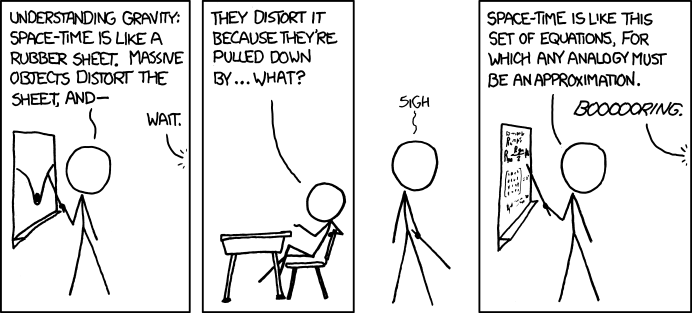
In many respects, this dilemma is much like the following assessment of analogy in xckd's "Teaching Physics":
The scroll-over text reads: "Space-time is like some simple and familiar system which is both intuitively understandable and precisely analogous, and if I were Richard Feynman I'd be able to come up with it."
Similarly, a fine-grained analysis of Flatland reveals the same problem: at some level, all analogies must break down.
If you have read this far, please mention Bananas in your comment below.
In the next part, I'd like to (hopefully) saunter on over to the question of autonomy/free will, and why this philosophical paradox isn't so daunting if you look below the surface.
Similarly, a fine-grained analysis of Flatland reveals the same problem: at some level, all analogies must break down.
Weren't you talking about that bat guy?
My, someone's intolerant of digression...
But to get back to the heartwood of Nagel's proposition, it seems there needs to be a distinction made between the ability to persuasively explain an idea and its validity. Just because the current batch of scientists happen to use analogy when either a) popularizing their work to the general public or b) appealing to the potentially "resolvable" nature of the dilemma, doesn't automatically mean their ideas are totally trivialized.
After all, didn't Newton concede his utter bewilderment about the mechanism for his theory of gravity, despite its overall coherence with all observation?
Furthermore, in evaluating the claims of the consciousness arguments, shouldn't we be mindful of Michael Faraday's famous statement?:
"Nothing is too wonderful to be true, if it be consistent with the laws of nature"So now we've landed right amidst the thick of the whole dilemma, where the discourse has become just abstract enough to be discouraging (if you're into precision 'n stuff).
If you have read this far, please mention Bananas in your comment below.
In the next part, I'd like to (hopefully) saunter on over to the question of autonomy/free will, and why this philosophical paradox isn't so daunting if you look below the surface.
Granted, that may sound pretentious and unfounded, but hey, if you're willing to stick around, that actually might not be the case.


No comments:
Post a Comment