Friday, June 10, 2011

DNA and complexity: terribly sorry, cabbages might have us beat...

*not part four of the consciousness thread, but something else entirely mostly*

Astute readers 
may have picked up on the 
superficially counter-intuitive
commentary on complexity
in last [time unit]'s post:


"So, it could be something as 'simple' as a bacteria, a virus, or fruit-fly?"

The reasoning for the quotation
(aside from an acknowledgement 
that the term has a fairly loaded 
and non-universal set of connotations)
was meant to hint at the enormously challenging problem
of reconciling our views of  the "complex"
with what actually exists.

Ah, hang on now, mate, 
you've lost me with 
your seemingly pointless 
abstraction...

Well, starting with the premise that 
the use of the word "simple" in the previous post
met with no intuitive objections
(unless you're in the field and know the hook to be baited),
let's ask the question:
"Why is it that we can easily imagine [bacteria/viruses/fruit-flies] as simple?"

Ah! you're sneaking up on word-mongering...
Why are we asking this "why" question?

Given that we, 
either as a species or as a culture,
(let anthropologists decide)
seem so keen on the idea of... 
...flaunting our complexity, IE;
"Ah, but you see a monkey could never have written Shakespeare" or 
"A computer will never be able to write a great symphony!"
[or perhaps more unnervingly, the following image]
If symbols are useless without context, what do we use to encode the context?

and... 
...given that this blog has
 managed to blunder about 
haphazardly
 in topics that concern
 human "human-ness",

...we'd better be damn sure what we mean when we talk about complexity or it's funny little complement, simplicity.


So, to the why question!

Yes, why is it so easy to think of these things as simple?

Well, perhaps we encode values for "complexity" 
based on the functions 
we have observed about an object...

In this case, it might be very easy to dismiss 
the microbial world as somehow simpler
 than we naked apes,
but only because we get by
by imagining them as little black boxes,
with their inner workings obscured 
nearly permanently
 from us 
throughout all our encounters with them (the microbes).

So where are we going with this?
Part of the inspiration 
for this post
was a remark by the geneticist Steve Jones
on a BBC Radio 4 program called the
"Infinite Monkey Cage", which went something like the following:

"I think the biggest question [in biology] is 'Why are there so few genes?' As everybody knows, we've sequenced the human genome, and we can now do it with extraordinary speed...
...now that we've read it off, it turns out that there are remarkably few genes
-when I was a student some years ago, around I'd say...the origin of the universe more or less, we used to believe (and we were told) that there were hundreds of thousands of genes, possibly millions of genes to make anything as beautiful and elegant and generally marvelous as, for example, me. That seems reasonable. 
 
It now turns out that there's only about 24,000 genes...to make a human, and that's less genes than it takes to make a cabbage."

So, at first this may strike you as an affront to our human special-ness (read: complexity) -and it may well be- but consider the question "Why are we surprised that a cabbage has a larger genome?" which ties in quite nicely into the early bit on complexity.

I suspect,
posited the blogger boldly,
that our surprise has to deal with ideas like 
intelligent design being special special-beings,
which have been particularly difficult 
to completely eradicate.

Now, I could talk about the really messy (and wonderful!) intricacies of 
DNA, information theory, and (formally defined) complexity...
...except that I am not qualified to do so.

Instead, I'll throw out leads like "junk DNA", "irreducible complexity", and "neutral evolution" 
to whet your appetites for a more thorough and rigorous treatment of the topic. 
(For those of you who protest the use of Wikipedia, sod off, it is only Wittgenstein's ladder a tool) 

If you're relatively familiar with cell biology (and even if you're not),
 Skeptic Wonder has a fantastic defense of neutral evolution that can be found here
which jives quite well with the following video (and quote):


"Well, many biologists will tell engineers and others, organisms have millions of years to get it right, they're spectacular, they can do everything wonderfully well. 
So the answer is biomimicry -- just copy nature directly. We know from working on animals that the truth is it's exactly what you don't want to do. 
Because evolution works on the just-good-enough principle, not on a perfecting principle. And the constraints in building any organism when you look at it are really severe. Natural technologies have incredible constraints. Think about it. 
If you were an engineer and I told you that you had to build an automobile but it had to start off to be this big, then it had to grow to be full size and had to work every step along the way. Think about the fact that if you build an automobile I'll tell you that you also inside it have to put a factory that allows you to make another automobile."
So what is this all building towards?
Consider the next hypothesis: 

Is it possible that the reason we're surprised by 
our evident lack of complexity (and things like non-coding DNA) is because
 we still cling, perhaps subconsciously, to the notion that we are exquisitely crafted for existence, 
with each bit and codon fixed perfectly for our lives, 
and not a hair more or less? 

"Left as exercise for the reader" 

For those of you protesting that we've looped back inadvertently on the debate around the anthropic principle (or similar ideas), yes, this is a possibility, but it may have been worth the ride.

See you in the future!

Monday, June 6, 2011

part three...where do we go from here?

Hello again, internet.

Last [time unit], 
we started diving into 
the dizzying array of complexity within
 a generic cell in the human body.

While the beauty of such a system 
might leave you mystified even at the nth glance,
it still might be easy to dismiss the automation
as independent of consciousness.

What are you implying by 'independent'?

Well, in a simplistic nutshell,
imagine David Bolinksy  
hadn't told us
this was a human cell.

So, it could be something as 'simple' as a bacteria, a virus, or fruit-fly?

Exactly! 
[Forgiving the architectural differences
 between eukaryotes, prokaryotes, and viruses]

Ok, so it's hypothetically not a human cell. Why is this relevant?

The relevance of this extra bit of information is all based on 
the audience's range of reactions to the images presented. 

When we might think of a bacteria, fruit-fly, or (especially) a virus, 
we're not surprised at all to imagine they are governed by some 
fixed, instinctual behavior. 

We don't ever have to engage in a debate of free will, 
because we've short circuited the debate by 
not endowing them with any form of consciousness.
 In fact, this jives quite well 
with our understanding of such critters. 

Think about the language we use to describe biological experiments with such species:
terms like "programming", "genetic code", "molecular machinery", et al.

Okay, fine. So little bugs are like robots. 
I'm cool with that.
What does this have to do with consciousness?

Well, here's where it gets complicated(ish).

There are vast expanses of our biology
 that use the same fundamental ideas and terms as
the research tinkering with E. coli etc. 

e.g.;
"Mr. So-and-so, the lab tests came back and we found that 
your body has a genetically-based
 inability to manufacture a certain enzyme..."

Okay, yes, you might say, I'll admit that some parts of my body are automated in a sort of predetermined way. Perhaps it's time for some more powerful examples. 

When you, internet,
woke up this morning,
I'm sure the first thing you thought about was the need to 
change the way your heart beats as you get out of bed. 

When you, internet,
opened your eyes from the darkness of dreamland,
and assaulted your retinas with cascades of photons
from the small whale oil lamp,
I'm sure you remembered
to contract the ring of muscles in your eye
that we call the iris.

When you, internet,
prepared breakfast,
I'm sure you remembered to 
tell your salivary glands to get to to work
pumping out a concoction of enzymes.

I'm sure you also placed careful attention
to making sure your esophagus 
moved in smooth, wavelike oscillations
in an effort to deliver the food effectively
to the roiling pit of hot, frothing hydrochloric acid.

You probably then went on to make sure your stomach 
communicated with the rest of your body 
to suppress your appetite.

Okay, so far this has been far from earth-shattering.
I'm comfortable with the idea that bits of my body are 
beyond my control. 

So what if digesting my food doesn't require conscious thought?

That's an understandable objection.
After all, that was only 
a (staggeringly) brief list
 of bodily functions that
 we're already accustomed to not controlling.

I'm sure that when you last fell asleep
(after carefully telling your brain to shift to the proper mode)
you remembered to keep breathing.

I'm sure that as you drifted off to sleep 
by counting prime numbers,
you reminded yourself to keep the steady pace
of inhaling and exhaling
making absolutely certain to keep the flow of air to your lungs
constant.

I'm sure that when you got out of bed,
stumbling across the room as you shake off the stupor,
you remembered to remind your legs
the perfect sequence for balancing.

After all, you might give a lot of thought to 
the same process while...hiking, or rock climbing, right?

Ok, I see where you're going with this.
But the claims you make implicitly in the examples
are totally uncontroversial.

I mean, hey, can't I walk and talk at the same time?

What about more intimate examples?

I'm sure that you, internet,
while [commuting verb] to [place that's not home]
you reminded your brain and ears
to be on the lookout
for that certain song from [memory lane].

I'm sure you perused the incoming information,
the beats, the tones, the hums,
the snippets of lyrics and fractions of symphonies
diffusing out from the construction crew doing roadwork,
the latest i[device],
or the obnoxious sub-woofer.

I'm sure you then compared all these bits of audio
to the data-bank inside your memory
scanning and analyzing
patterns, genres, reflections,
permutations,
searching for a link across time
to a forgotten musical fingerprint.

I'm sure you then chose to recall said song
in all its glory
replaying inside your mind's eye ear
again for the first time in [x]
and again
and again
 and again.


Okay, yes, this I can deal with. 
Assign some functions to the subconscious, 
that's fine.

But there are still plenty of things
(that are not formally called instincts)
that I know I choose to do.

What about really complicated parts 
of our consciousness,
like...love 
(romantic or otherwise)?

Ah, what an excellent point you bring up.
After all, it does sound a little cheap
to say that something as complex 
as the rush of emotion
you feel
when seeing the face of a loved one
can't possibly be explained 
by a surge of chemicals
or a wild-firing of synapses
deep within the brain.

I'm sure that you, internet,
upon seeing for the first time
your [current significant other],
were reminded of the 
decision you made
 earlier in the day:
to carefully scan the sweep 
of your visual field
searching all the while
for a face (or body) 
you had preconceived as beautiful.

I'm sure that upon seeing 
said significant (other),
you reminded some neurons deep within your brain
(and perhaps elsewhere)
to let loose the love signal!

I'm sure you reminded your eyes,
instead of jumping butterfly-like
from point to point 
at a frenzied pace,
to stop
and smell the roses.

I'm sure you reminded yourself to be 
more mindful of your posture, your smile, 
and set your heart beating, just a little faster.

 Perhaps there was even 
increased sweating involved
...all deliberate, of course.

Aha! Your clever attempt at swaying my opinion has failed.
I, said the internet boldly, am no silly romantic.
I don't believe in this whole "love at first sight" thing.

Fair enough.
Perhaps you'll want to stick around for the future
(you'll be there anyway, if you're lucky).

In the next part, we'll take a stab at
some kinds of takeovers of consciousness
the instances of veritable "body snatchers"
in the lives of mice and hominids.

If you've read this far, stop.
It's okay, the post is done.
Go about your business.


Sunday, June 5, 2011

part two...if you're still around

hi there!

I don't know about you, internet, 
but I'm one of the bandwagon riders who ascribes to 
this thing called the "germ theory of disease"
I know, I know, it so mainstream and all, 
but the quirky thing about science is that 
to be a hipster, you're guaranteed to either
 be a yet-unnoticed revolutionary or a quack
 (these categories can even overlap for a single individual).
 I'm sure the miasma theory still has some adherents, 
mostly the mosquito lobby, certain South African politicians
and Jenny McCarthy

Hey don't you think  throwing in 
a concerned parent's take on autism is 
a bit hyperbolic given the contents of your list?

No.

...returning from a potentially caustic diatribe...

So if you're one of those folks who
 openly spits in the face of Pasteur 
-which is fine; science has no gods beyond the reach of criticism
this next bit might not jive so well with you. 
Read it anyways. 
Worst case, you find out you're wrong 
(and you're now made smarter for it), 
best case, I'm wrong, and you have further kindling for your debate. 


Part of the cool  thing about our bodies
 is that so much complexity is racing around 
at mind-boggling paces and  reactions,
all hidden enigmatically beyond the veil of our awareness
...or something.

But, to better illustrate this, 
let's scuttle across the interwebs to 
the work of a hominid called David Bolinksy
who brought the world this astonishing gem:


(Or, if you're particularly impatient and want to skip over what is really an eloquent prelude to the actual artwork, click here.)


"These are expressions of truth as awe-ful things, 
by meaning, they are things you can worship. 
They are ideals that are powerful, 
they are irreducible, they are unique, they are useful
 - sometimes, often a long time, after the fact."


I've promised to keep the posts on the shorter side for your viewing pleasure, so I'll break this one off here, but the goal is to get you thinking about the weirdness of a cell, the automation, the machine-like beauty of it all. 

And hey,
if you should come out of the experience 
with a sense of awe for the beauty of life,
well
that wouldn't be too bad.


Stay tuned for more, if that's what you're into.


Friday, June 3, 2011

part one of...several

So, here we are, internet. 


Today marks the first part of a soliloquy on *drum roll*  consciousness. Oh, wunderbar, I can hear you groan: another lengthy discussion from a word-mongering amateur. 


Well, yes, possibly.

I'd like to take a shot at trying to assess why people (myself included) seem to have a hard time accepting the arguments surrounding free will in philosophy, partly because it's interesting to see how we handle new ideas, and partly because I'm barely qualified to waste your time with anything else. 


So! where to begin... 

I need to start with a modest assumption about consciousness 
before starting off. I'll assume (and perhaps you do as well) 
that we humans are rather fragile creatures, 
and that when our bodies wear out with time (or rogue buses), 
when our bones ache and our brains struggle to thrive, 
that our mind is essentially destroyed, finished, kaput.

A little frightening, perhaps, but hey, 
could you ask for a better reason to live life?

So this life, this body, this...brain, it's all that we've got to work with for now (unless you fall in with Kurzweil or the Vatican, to name a few).

Okay, okay, I hear you scoffing. "So we die, and that's it. Not exactly worth a trip to meet the king of Sweden." Fair enough.

Let's get to the thick of it.
What is it about our sensibilities towards consciousness that makes arguments against free will so damn unsettling?

Well, to take a stab at answering the question, it might be useful to think about what kind of arguments are being made, and (perhaps more importantly) how they are being made. What does this mean?

Consider the following analogy made by the late, great Douglas Adams, when trying to dissuade his audience from any lingering attachments to the anthropic principle:

"Imagine a puddle waking up one morning and thinking, "This is an interesting world I find myself in — an interesting hole I find myself in — fits me rather neatly, doesn't it? In fact it fits me staggeringly well, must have been made to have me in it!" This is such a powerful idea that as the sun rises in the sky and the air heats up and as, gradually, the puddle gets smaller and smaller, it's still frantically hanging on to the notion that everything's going to be alright, because this world was meant to have him in it, was built to have him in it; so the moment he disappears catches him rather by surprise."

So you might be thinking: Okay...I think I see what he's saying. 
I get the whole "don't be a schmuck, 
nature doesn't have to keep you around, 
you're no special hotshot in the cosmos, yes yes".

but what the hell does this have to do with consciousness?


Alright, here's where it might get interesting.

Think about the kind of analogy that Adams is trying to persuade us with. 
In order to show that our fixation with "just so" conditions is a bit unjustified, he likens this yearning for a kind of "specialness" to the musings of the puddle, who conveniently enough also resides in a physical world. 

But...(and let me be explicitly clear that this is not an endorsement of religious ideologies)
...there is a bit of a problem.

Let's consider the world of the puddle, from the perspective of some variety of "designer".
Now the puddle, which is physical, resides in his environment pretty much exactly like we do, except perhaps for the benefits of remarkable advances in twig technology. But in order to be consistent with the ideology, we'd have to say that the "designer" had at least some say in the creation of both the puddle and the swell little niche he dwells in. 

Now wait a second, I can hear you object. Hold the phone, you might cry out.
Isn't that an absurd extension of the philosophy? 
Well, not so much, if you think about it.

 We could hover around the scale between Newton's watch-maker and the heaver interventionist models, but the fact remains that if it's part of a creation, some thought must have been given to its arrangement. 
(For those of you tempted to respond with a crack about the seemingly alien-ness of the platypus, I challenge you to find a more elegantly crafted critter for the circumstances.)

If you're willing to cede me that point, consider this next point. Adams, if trying to argue within a creationist framework, has gone and painted himself into a corner. 

Option one: he could take a physical example, anthropomorphize it so we can ridicule the ignorance, and point out the absurd nature of our fallacy. But then "aha!" the creationist might declare triumphantly. "Of course the hole was made special for the puddle. He's part of creation!"

or...

Option two: He could simply use a non-physical example and...er...wait a second...


Now, this is by no means an argument against Adams' point. The odds are terrific given simple historical observation that the life of an individual is of no great import to the cataclysms we call Nature. 

The takeaway here is this: the same sort of tricky dilemma occurs all the time with debates about consciousness, because they often ask us to consider the existence of some "not-conscious" state. 

okay...you had me at Adams, where is this going?

There's a nifty little thought experiment that's often cited in psychology, philosophy, or the cognitive sciences from a hominid by the name of Thomas Nagel titled "What is it like to be a bat?".


Yes, I hear you cluck derisively, Nagel does argue against what some call "reductionism", such as your earlier quote from VS Ramachandran. Let's not claim otherwise. However, the structure of his argument is of interest.

Let's look at some of the language Nagel uses for his bold proposition:
"Every reductionist has his favorite analogy from modern science. It is most unlikely that any of these unrelated examples of successful reduction will shed light on the relation of mind to brain.
But philosophers share the general human weakness for explanations of what is incomprehensible in terms suited for what is familiar and well understood, though entirely different...
...I shall try to explain why the usual examples do not help us to understand the relation between mind and body—why, indeed, we have at present no conception of what an explanation of the physical nature of a mental phenomenon would be."
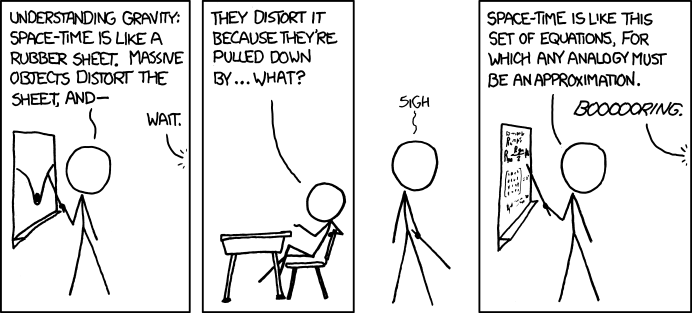
In many respects, this dilemma is much like the following assessment of analogy in xckd's "Teaching Physics":
 Teaching Physics
The scroll-over text reads: "Space-time is like some simple and familiar system which is both intuitively understandable and precisely analogous, and if I were Richard Feynman I'd be able to come up with it."


Similarly, a fine-grained analysis of Flatland reveals the same problem: at some level, all analogies must break down. 


Weren't you talking about that bat guy?

My, someone's intolerant of digression...


But to get back to the heartwood of Nagel's proposition, it seems there needs to be a distinction made between the ability to persuasively explain an idea and its validity. Just because the current batch of scientists happen to use analogy when either a) popularizing their work to the general public or b) appealing to the potentially "resolvable" nature of the dilemma, doesn't automatically mean their ideas are totally trivialized. 

After all, didn't Newton concede his utter bewilderment about the mechanism for his theory of gravity, despite its overall coherence with all observation? 

Furthermore, in evaluating the claims of the consciousness arguments, shouldn't we be mindful of Michael Faraday's famous statement?:
"Nothing is too wonderful to be true, if it be consistent with the laws of nature"
 So now we've landed right amidst the thick of the whole dilemma, where the discourse has become just abstract enough to be discouraging (if you're into precision 'n stuff). 


If you have read this far, please mention Bananas in your comment below.


In the next part, I'd like to (hopefully) saunter on over to the question of autonomy/free will, and why this philosophical paradox isn't so daunting if you look below the surface.


Granted, that may sound pretentious and unfounded, but hey, if you're willing to stick around, that actually might not be the case. 


Thursday, June 2, 2011


"You know, philosophers love rational argument...
...it seems as if the ideal argument for most philosophers is: 
you give your audience the premises, 
and then you give them the inferences and the conclusion, 
and if they don't accept the conclusion they die; 
their heads explode!
...but in fact that doesn't change people's minds at all."
Dan Dennett

“The important thing is not to stop questioning. Curiosity has its own reason for existing.”
Albert Einstein


“All life is an experiment. The more experiments you make the better.”
Ralph Waldo Emerson


"What is the self? 
How does the activity of neurons
 give rise to the sense
 of being a conscious human being? 
Even this most ancient of philosophical problems, 
I believe, 
will yield to the methods of empirical science."
VS Ramachandran


"As our knowledge [of physics] grows like an island, so too will the shores of ignorance increase."
Marcelo Gleiser


"...So throw off the bowlines. Sail away from the safe harbor. 

Catch the trade winds in your sails. Explore. Dream. Discover.”

Samuel Clemens